
The #CancelCoal Timeline
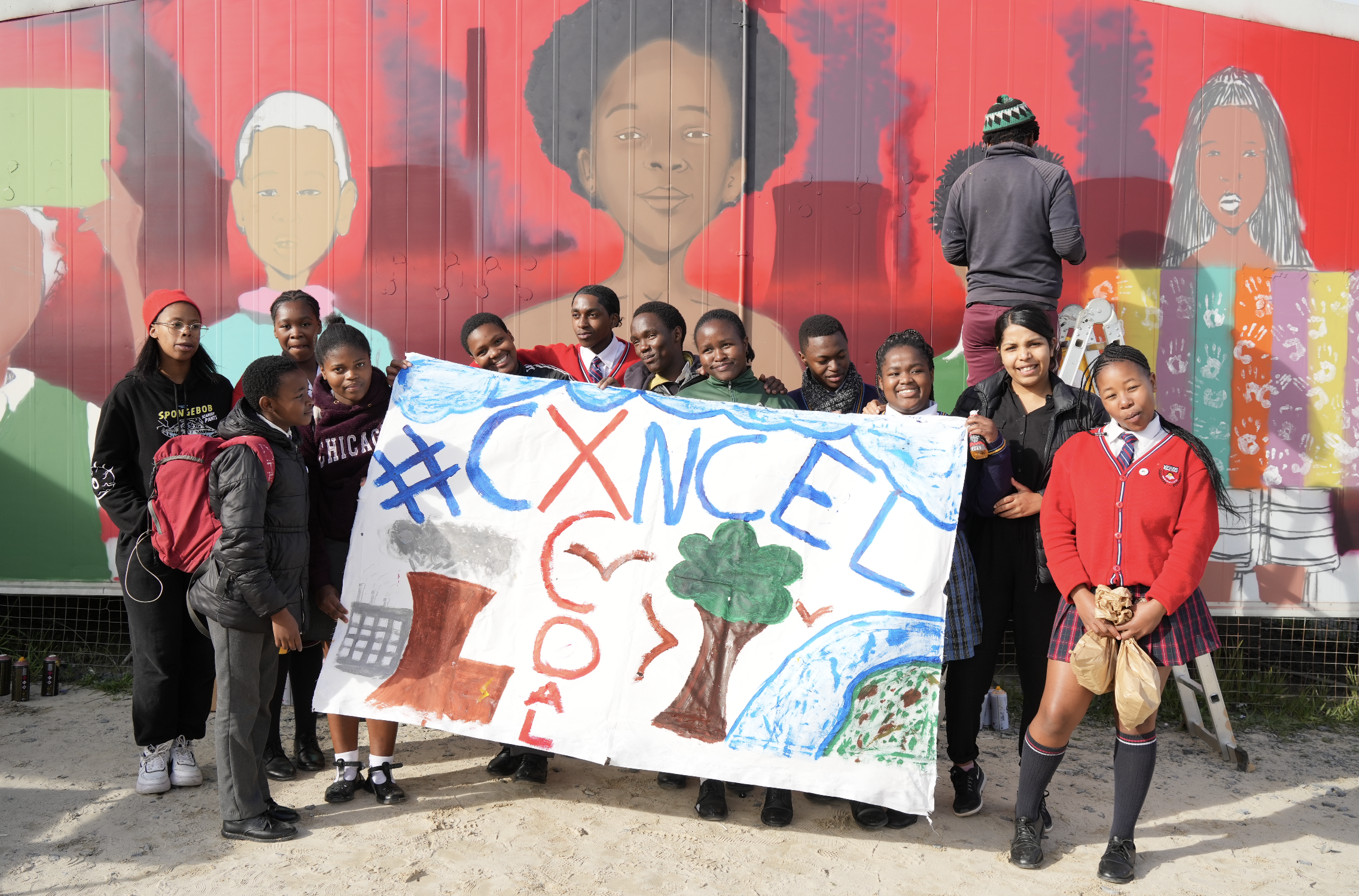
The #CancelCoal case began in 2021 when the African Climate Alliance, Vukani Environmental Justice Movement in Action and groundWork challenged the government’s plans to procure 1,500 MW of new coal-fired electricity.
Since then, the case has moved through three major phases: building the case against new coal, securing a landmark High Court victory and defending that victory before the Supreme Court of Appeal.

Phase 2: Securing a Landmark Victory
April–December 2024
The government defended its new-coal plan by citing energy security and “clean coal,” but provided little evidence that these technologies were feasible or that children’s rights had been properly considered.
Supported by the Centre for Child Law and the Vaal Environmental Justice Alliance, we argued that the health, climate and rights impacts of new coal had to be assessed before it was included in the national energy plan.
On 4 December 2024, the High Court ruled in our favour, declaring the proposed 1,500 MW coal procurement “unlawful and invalid.” The judgment affirmed that energy planning must take children’s rights and best interests into account.

Phase 1: Building the Case Against New Coal
November 2021–September 2023
In November 2021, ACA, VEM and groundWork challenged the government’s plan to procure 1,500 MW of new coal-fired electricity. We argued that it had failed to properly consider the effects on children, frontline communities, public health and the climate.
After the Minister failed to provide all the records behind the decision, we took legal action to obtain them. In November 2022, the High Court ordered their release—an important early victory that allowed the case to proceed.
In September 2023, we strengthened the case with further evidence challenging the government’s reliance on so-called “clean coal” and showing that it would not remove coal’s serious health, pollution and climate impacts.
Phase 3: Defending the Victory
The government appealed the High Court judgment, arguing that the case was no longer relevant and that national energy policy was not a matter concerning children.
We defended the judgment because its principles extend beyond one coal plan and could shape future decisions about coal, gas, nuclear power and other energy developments.
In August 2026, the case was heard by the Supreme Court of Appeal. At stake was whether children’s rights and community voices must be meaningfully considered before government makes long-term energy decisions. We are now awaiting the SCA’s judgment.
-
We await the judgment.
We are now awaiting the Supreme Court of Appeal’s judgment. The outcome could shape how children’s rights and community voices are considered in future energy planning across South Africa.
-
The case reaches the Supreme Court of Appeal.
On 19 August 2026, the Supreme Court of Appeal heard the government’s challenge to the High Court victory.
We defended the principle that children and affected communities must be meaningfully considered before government makes long-term energy decisions.
-
On 4 December 2024, we received the news that we had won the court case!
In a landmark ruling, the High Court of South Africa has overturned the government’s plans to add 1,500 MW of new coal-fired power to the national grid, saying they are “unlawful and invalid.”
-
After three years of litigation, the landmark Cancel Coal case was heard in Pretoria High Court on 9 and 10 October.
The argument in court centred around the failure of the state respondents to ensure adequate consultation with youth, children and representatives of future generations. Due to the intensifying nature of the climate crisis, unchecked climate change will impact most heavily on children whose lives are still ahead of them. Additionally, it is children, (along with elderly people and those with respiratory health conditions) who are the most vulnerable to the toxic air pollution emitted by coal fired power plants.
Now, we await judgement.
-
15 July 2024 – The applicants file our Heads of Argument, which are a parties’ written legal arguments and key points that the legal representatives intend to present during oral argument at the court hearing. The Heads of argument emphasise and expand on the legal principles around the 3 main points of the applicants’ arguments in this case, namely:
The failure to assess the impact on children’s rights
: the Minister and NERSA failed to give adequate consideration to the impact of their decisions on the rights of current and future generations of children and thus failed to uphold the best interests of the child.
The failure to assess the feasibility of so-called “clean coal” technologies: the Minister and NERSA premised their decisions on the belief that “clean coal” technologies would prevent all harms, but now admit that they made no attempt to assess whether these technologies can feasibly address the admitted dangers.
The unjustified limitation of rights:
the Minister and NERSA offer no adequate justification under section 36 of the Constitution for the limitations of the rights of children and vulnerable people, including the section 24 environmental and socio-economic rights.
-
21 June 2024 - The applicants file our replying affidavit, which is a joint response to both the Minister and NERSA’s answering affidavits. The replying affidavit emphasises that children will have to live with the consequences of coal-fired power stations, including climate change, air pollution, and water pollution, throughout their lives. The decisions themselves and the reasons offered by the Minister and NERSA fail to make any mention of the rights and best interests of the children. However, there is no documentary evidence of any children’s rights impact assessment being conducted by the Minister or NERSA. The applicants further argue that it is entirely inappropriate for such consequential decisions, which threaten severe climate change and human health consequences, to be made in the absence of any credible information or studies showing that HELE technologies can indeed prevent the harmful effects of coal-fired power. Therefore, the applicants argue that the Minister and NERSA’s decisions were irrational and unreasonable. These decisions are also inconsistent with the duty of these decision-makers to make decisions in the public interest and in a manner that protects rights.
-
02 May - The Minister of the DMRE files his answering affidavit in the main application. In the answering affidavit, the Minister denies that the inclusion of 1500 MW of new coal in the 2019 IRP is a threat to any constitutional rights (i.e. the right to an environment that is not harmful to one’s health and well-being and the right to have the environment protected for the benefit of present and future generations, the right of children to have their best interest considered in every matter concerning them, the right life, human dignity and equality amongst other rights). The Minister further argues that in light of certain reasons, including the country’s electricity needs, the contribution of other fossil fuels to greenhouse gas emissions, and the Minister’s obligation to ensure uninterrupted power supply, if the inclusion of 1500 MW of new coal in the IRP is a limitation or a threat to constitutional rights, there is a legitimate purpose for its inclusion and the court should not interfere with the decision to include new coal at the IRP and determination stage.
The Minister does not deny the impact of coal fired power generation on human health, however, when referring to these impacts he refers to them as “historic” and insists that the 1500 MW of new coal proposed by the IRP 2019, will use “clean coal” technology.
31 May 2024 - NERSA files its answering affidavit. In the answering affidavit, NERSA argues that the absence of feasibility studies on so-called High Impact Low Emissions (HELE) technologies does not render NERSA’s concurrence with the Minister’s determination unconstitutional or unlawful. The coal master plan would necessarily require studies on the feasibility of HELE technologies. Furthermore, NERSA claims that it is satisfied that the determination is in line with South Africa’s CO2 emissions constraints, based on its commitments to reduce emissions in terms of the Paris Agreement. Furthermore, while NERSA agrees that the new coal envisaged was more expensive than renewable energy, NERSA is satisfied that new coal is still comparable with other technologies like renewable energy plus storage. NERSA also considered the socio-economic benefits of coal. In addition, NERSA asserts that they had a meaningful consultative process where stakeholders provided their comments in writing and that these comments were thoroughly considered by NERSA before they concurred with the Minister’s determination.
-
The Minister of Electricity is officially joined to the case as the Fifth Respondent. This decision follows a joinder application submitted by the applicants, citing the Minister’s likely pivotal role in determining new generation capacity in future . It is anticipated that the Minister will become the official responsible for issuing any fresh determination that may be mandated by the court.
-
In a significant development, the Cancel Coal court case has taken a new turn with the inclusion of the Minister of Electricity.
After a 17-month delay caused by the Minister of Mineral Resources & Energy’s failure to release all relevant records, the applicants filed their supplementary founding affidavit on September 6, 2023. The Minister of Electricity’s newly acquired powers in determining new generation capacity make his inclusion in the case necessary.
Now, the #CancelCoal applicants await the government’s responding affidavits as they continue grassroots mobilization and capacity building, striving for a just future.
-
In an initial legal victory for the #CancelCoal court case, the High Court of Pretoria ordered the minister of Mineral Resources and Energy to release documents relating to Minister Mantashe’s decision to include new coal power in the 2019 Integrated Resource Plan for Electricity (IRP), and the 2020 Ministerial determination for new coal, also issued under the IRP. This is an important step in clearing the way for the main #CancelCoal case to proceed.
This comes after the African Climate Alliance, Vukani Environmental Movement, and GroundWork filed a rule 30A application compelling the mininster to release planning documents relating to his decision to include new coal in the IRP after the minister had refused to provide these documents. -
On November 16th, ACA and other applicants went to the Pretoria High Court to bring the 30A application to compel the Minister of Mineral Resources & Energy to release records relating to the Minister’s decision to include new coal power in the 2019 Integrated Resource Plan for Electricity (IRP), and the Ministerial determination for new coal issued under the IRP.
On 25 November the initial legal victory took place when Michau AJ of the Pretoria High Court ordered the Minister of Mineral Resources and Energy to release records relating to the Minister’s decision to include new coal power in the 2019 Integrated Resource Plan for Electricity (IRP), and the 2020 Ministerial determination for new coal issued under the IRP. The court ordered the Minister to release the documents in question within 10 days and ordered government to pay costs, clearing the way for the main #CancelCoal case to proceed.
-
In May Minister Mantashe stated that he intended to oppose our application to get all the documentation needed. This came as no surprise and can be seen as an obstructive tactic to delay the case. We, however, proceeded with the appropriate course of action against the Minister.
NERSA on the other hand had requested that we give it an undertaking that we would not pursue an order against it. NERSA stated that it had provided us with complete records despite not providing us with all of the documents we had requested nor providing us with an affidavit stating that these documents do not exist. So whilst we will not be taking further action against NERSA it does highlight questions around the lawfulness of NERSA supporting Minister Mantashe in his decision to allow for the procurement of new coal in our IRP.
-
In April we as the applicants filed a rule 30A application against Minister Mantashe. This is a separate smaller court application to force the Minister and NERSA (by order of court) to provide us with the outstanding record documents that they have failed or refused to provide which are necessary for the case to proceed.
-
On 1 February 2022 we released another public update on the case after Minister of Mineral Resources and Energy, Gwede Mantashe, and the National Energy Regulator of South Africa (NERSA) officially responded to state that they will be opposing the cancel coal court case in court.
-
The case launches
COURT CASE APPLICANTS


REPRESENTED BY

