Government Appeals Landmark Youth Climate Court Victory as #CancelCoal Case Returns to Court
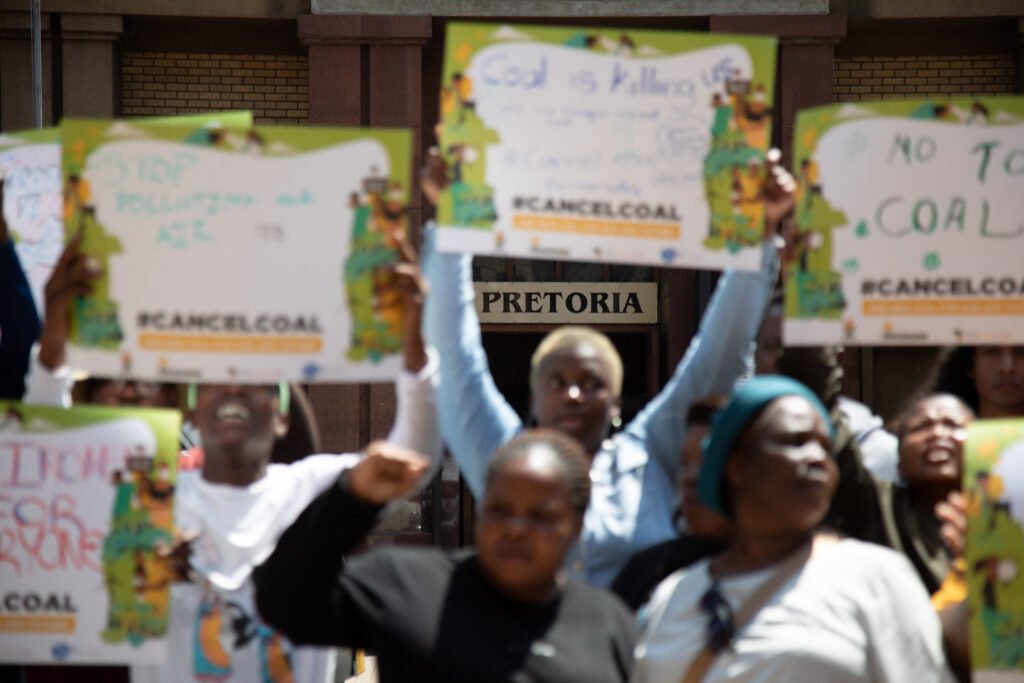
Applicants gather outside the Pretoria High Court in October 2024 during the High Court hearing. Photograph by Chris Louw.
FOR IMMEDIATE RELEASE
Date: 12/08/2026
Government Appeals Landmark Youth Climate Court Victory as #CancelCoal Case Returns to Court
The #CancelCoal case returns to court on the 19th of August 2026 as the Minister of Electricity and Energy, Dr Kgosientsho Ramokgopa, appeals the High Court judgment handed down in favour of youth-led climate justice organisation African Climate Alliance (ACA), and environmental justice organisations Vukani Environmental Justice Movement in Action (VEM) and groundWork, collectively represented by the Centre for Environmental Rights (CER).
As air pollution wafts through the winter air, the government’s appeal challenges the High Court’s ruling that struck down the plan to procure 1 500 megawatts (MW), the equivalent of three to four large coal-powered power plants, under the 2019 Integrated Resource Plan (IRP). The Court found no evidence that the Minister or the National Energy Regulator of South Africa (NERSA) adequately considered the harms of new coal to health, air quality, the environment, or children’s rights before approving the plan.
With the publication of the 2025 IRP, which contains no provisions for new coal, the appeal remains significant. It clarifies the legal obligations of decision-makers in future energy and environmental policy, particularly how thoroughly children’s rights and environmental harms must be weighed before similar decisions are taken again.
Why this case matters
Air pollution from coal-fired power stations kills more than 2,200 South Africans every year and causes thousands of cases of bronchitis and asthma in adults and children annually. For the first time in South Africa’s history, young activists and community organisations are leading a constitutional challenge to stop new coal. The benefits of ending new coal reach far beyond young people alone. New coal is expensive to build and will push up electricity costs for everyone, pollute the air, deepen job precarity, and accelerate climate change.
Coal-fired power is the single largest contributor to South Africa’s greenhouse gas emissions and among the largest historical contributors to global warming, placing South Africa among the world’s top 15 emitters. The World Health Organisation has declared air pollution one of the world’s greatest public health threats; the cost of air pollution in South Africa is estimated at over R980 billion a year, equivalent to 14% of GDP. The 2019 IRP would have committed the country to a further 30 years of new coal-fired power, undermining efforts to limit South Africa’s contribution to climate change.
The Respondents’ case
The organisations argue that the Minister and NERSA failed to consider the impact of new coal-fired power on children’s rights, as required by sections 24 and 28(2) of the Constitution. They highlighted that there was no evidence of a children’s rights impact assessment, nor any mention of children or youth in the decision records. They argue the Minister’s position that energy policy is not a ‘matter concerning the child’ is inconsistent with domestic and international legal standards requiring explicit consideration of children’s interests in environmental decisions.
They further argue that the plan for new coal-fired power unjustifiably limits the constitutional rights to a healthy environment, life, dignity, equality, food, water and healthcare. These are rights that fall especially hard on children and communities already living with pollution, and that the Minister and NERSA provided no sufficient justification for these limitations, nor evidence that new coal was necessary for energy security or more cost-effective than alternatives.
Respondents say:
Promise Mabilo, coordinator and founder of the Vukani Environmental Movement (VEM), ”Communities in the Highveld already live with toxic air. New coal means more illness, more funerals, and more injustice.”
Lisakhanya Mathiso, Movement Building Coordinator at African Climate Alliance (ACA), ”Air pollution and poor child health are direct impacts of South Africa’s coal mining. Because young people bear the heaviest burden of fossil fuel emissions, they must lead the shift toward a clean and fair energy future not only as beneficiaries but co-architects too.”
Thomas Mnguni, groundWork Coal Campaigner from Middleburg, ”It is an opportunity for both government and industry to provide health risk and climate change assessment, which will not only inform policy but ensure the protection of current and future generations”
Michelle Sithole, attorney, The Centre for Environmental Rights, ”This #CancelCoal appeal raises critical questions about how major energy decisions are made and whether their impacts on constitutional rights, children’s rights and the environment have been fully considered. It highlights the need for decision-makers to meaningfully consider the rights and best interests of children, who are among those most vulnerable to the long-term effects of air pollution and climate change. The Supreme Court of Appeal now has an opportunity to provide important guidance on these obligations for future energy planning in South Africa while we adhere to our climate change commitments.”
What happens next?
The appeal will be heard by the Supreme Court of Appeal in Bloemfontein on 19 August 2026 at 10:00 am.
[ends]
FOR EDITORS
The African Climate Alliance is a youth-led, grassroots organisation acting and advocating for Afrocentric climate justice (social, environmental, and climate change justice). The movement was born out of the first-ever major youth-led climate protest in Cape Town, South Africa, in 2019.
Vukani Environmental Justice Movement in Action, established in 2016 and based in Emalahleni, in Mpumalanga in the Highveld region of South Africa, is a non-profit organisation focused on environmental justice issues, including air pollution, climate and energy, water and sanitation, waste, and food gardens.
groundWork is a non-profit environmental justice service and developmental organisation working primarily in Southern Africa in the areas of Climate & Energy Justice, Coal, Environmental Health, Global Green and Healthy Hospitals, and Waste.
Centre for Environmental Rights is a non-profit organisation and law clinic based in Cape Town, South Africa. As a group of activist lawyers, CER helps communities and civil society organisations in South Africa realise the Constitutional right to a healthy environment by advocating and litigating for environmental justice.
Media contacts
Tsepang Molefe, +27 74 405 1257, media@groundwork.org.za
Alex Kayle, Centre of Environmental Rights, +27 82 827 8429, akayle@cer.org.za
Ivana Merckel, Life After Coal, +27 82 6233 170, ivana.impactethoscom.com
Legal papers & background
CER: #CancelCoal case back in court on 19 August 2026
SCA appeal record (Minister of Electricity and Energy v ACA and Others, case 516/2025)
Signed High Court judgment and background (4 December 2024)
Case background and #CancelCoal fact sheet: cancelcoal.org.za
